 BabyCalm
Here is how the weeks are counted, which symptoms show up and when, when a test makes sense and when it is worth calling your midwife or doctor.
Key points
- Pregnancy weeks are counted from the first day of your last period. The first two weeks happen before you are pregnant.
- According to the NHS, early symptoms usually start around weeks 4 to 6. Noticing nothing at first is normal.
- A missed period is often one of the first signs. Nausea can come at any time of day.
- Most pregnancy tests work from the first day of a missed period. If it is negative and your period still does not come, you can test again a few days later.
- Bleeding in pregnancy is not always serious, but it is worth having it checked by a professional.
What symptoms are there in the first week of pregnancy?
Week 1 is your period
The first week of pregnancy is, in practice, the week of your period. ACOG, the American College of Obstetricians and Gynecologists, explains that pregnancy is assumed to start two weeks after the first day of your last period. Those two weeks are counted even though you are not actually pregnant yet.
So whatever you notice in week 1 belongs to your period: bleeding, some cramping, maybe a little tiredness. It is not a sign of pregnancy either way.
Why the signs are easy to mix up
Several early pregnancy symptoms feel a lot like the days before a period. The NHS lists sore breasts, tiredness and cramping a bit like period pains among them. If you are paying close attention to every twinge, it is easy to read them as pregnancy, or as the opposite. Your body alone cannot tell you. That is what a test is for, at the right time.
How are pregnancy weeks counted?
From the first day of your last period, not from sex or conception. The NHS says so in its week 4 guide, and ACOG uses the same count: a pregnancy lasts about 40 weeks from that day.
It is a convention. Most people remember when their last period started, and very few know the exact day they ovulated. That date is used to work out your due date. If you are not sure of it, ACOG explains that a first-trimester ultrasound can estimate it by measuring the embryo. The NHS also has a due date calculator.
In practice, by the time you notice a late period, you are already counted as about four weeks pregnant. That is why week-by-week guides start talking about symptoms in week 4, not week 1.
What are the first symptoms and when do they start?
On its page about the signs and symptoms of pregnancy, the NHS says they usually start around weeks 4 to 6. These are the most common:
- A missed period, often one of the first signs.
- Feeling very tired after your usual daily activities.
- Larger, tender or sore breasts.
- Feeling or being sick, at any time of day.
- Needing to pee more often, without pain or discomfort.
- A metallic taste in your mouth and being more sensitive to some smells.
- New food cravings, or losing interest in foods you used to enjoy.
- Mood changes.
- Constipation and a little more vaginal discharge, without soreness or irritation. If discharge is on your mind, we cover it in discharge in the first trimester.
Light spotting
The NHS describes a very light bleed or spotting around the time your period would be due. It links it to the fertilised egg implanting in the womb. Because it can look like a short period, it is sometimes mistaken for one. Even so, the NHS advises getting any bleeding in pregnancy checked. You will find when and who to call further down.
If you do not notice anything yet
That is normal too. In its week 4 guide, the NHS explains that you may not have any symptoms at first, and that you could still be pregnant even if you have not noticed any. Every body and every pregnancy is different.
How do symptoms change week by week?
The NHS weekly guides describe the first trimester like this. Treat it as a rough guide: you may notice more, less, or things in a different order.
| Week | What the NHS describes |
|---|---|
| Weeks 1 and 2 | Counted from your period. You are not pregnant yet. |
| Week 4 | You may not notice anything yet. If symptoms appear: a missed period, sore breasts, tiredness, light spotting or cramping a bit like period pains. |
| Week 5 | Many women realise they are pregnant now, because their period is late. Extreme tiredness is common. |
| Week 6 | Nausea and tiredness. Nausea is often worse when you first wake up. |
| Week 12 | Many people start to feel better as the first trimester ends. Indigestion or heartburn may appear. |
If you want to know when the second trimester starts, we explain it in when does the first trimester end.
Nausea
According to ACOG, nausea usually starts before week 9 and, for most women, goes away by week 14. The NHS says it usually clears up by weeks 16 to 20. Both fit: it simply lasts longer for some women than for others.
For everyday life, the NHS page on vomiting and morning sickness suggests:
- Resting, because tiredness can make nausea worse.
- Avoiding the foods and smells that set it off.
- Having a plain biscuit or some dry toast as soon as you wake up.
- Eating small amounts often, ideally plain, starchy, low-fat foods.
- Choosing cold meals if the smell of hot food bothers you.
- Sipping drinks throughout the day.
The NHS adds that ginger may help, and to check with a pharmacist before taking it as a supplement. If you cannot keep food or fluids down for 24 hours, your pee is very dark or you have not peed for more than 8 hours, call your midwife or doctor. Do the same if you feel dizzy when you stand up, have tummy pain or a high temperature, vomit blood or are losing weight.
Tiredness and mood
The NHS lists mood changes among the symptoms of the first weeks, and its week 6 advice is simple: rest as much as you can. It also points out that feeling anxious or stressed in pregnancy is common. If it weighs on you, talk to your midwife or doctor.
When should you take a pregnancy test?
According to the NHS page on doing a pregnancy test, most tests work from the first day of a missed period. Some very sensitive tests can be used earlier. If you do not know when your period was due, the NHS suggests waiting at least three weeks after unprotected sex.
Two details that often cause doubts:
- It does not have to be in the morning. The NHS says you can use pee collected at any time of day.
- A positive is more reliable than a negative. A negative can come from testing too early or not following the instructions closely.
If it is negative but your period still has not come
The NHS suggests waiting a few days and testing again. If the second test is also negative and your period still does not arrive, book an appointment with your doctor to look into it calmly.
If it is positive
The NHS explains that a positive result is almost certainly correct. The next step is to contact your local maternity service or your doctor to start your pregnancy care. If you are unsure about continuing, you can also talk to a professional about it in confidence.
When is it worth calling your midwife or doctor?
Most early symptoms are normal. Even so, there are times when it is better to be seen. The NHS page on vaginal bleeding in pregnancy explains that bleeding is not always serious, but that it is always worth getting advice. If you have spotting or light bleeding, with or without mild cramps, call your midwife, doctor or early pregnancy unit.
Call your local emergency number if the bleeding comes with any of these:
- Severe tummy pain that stops you doing what you were doing.
- Shoulder pain.
- Feeling dizzy or faint, or losing consciousness.
- Heavy bleeding that soaks a pad soon after you put it on.
On its page about pregnancy symptoms you need to get help for, the NHS adds fever: a temperature of 38C or above is worth getting checked. And if you are not sure what to do, the advice is to ask. Calling about something that turns out to be nothing is fine.
How can you keep track of what you notice without the stress?
You do not need to write everything down. The date of your last period and two or three notes about what is on your mind are enough to arrive prepared at your first appointment. If you skip a day, nothing happens.
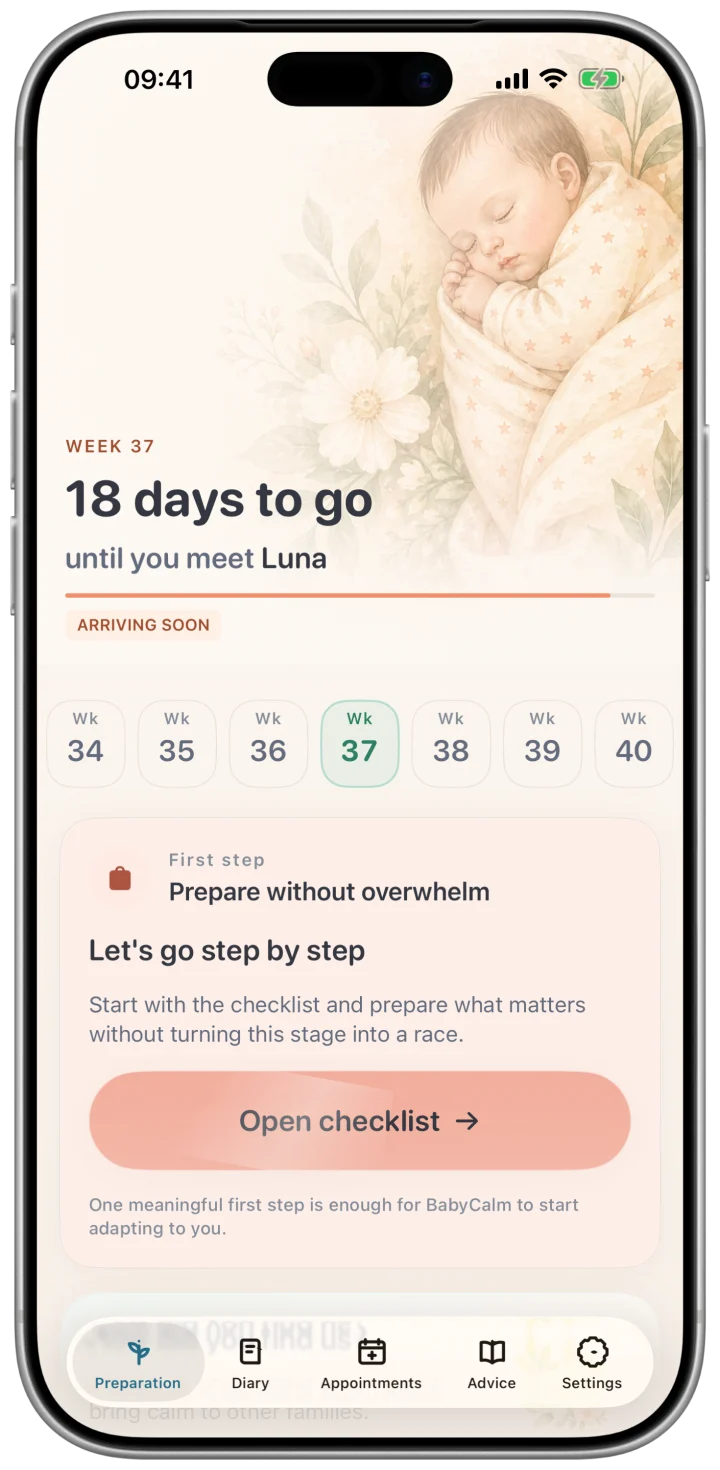
In BabyCalm, pregnancy mode shows your week, your preparations, a diary and your appointments. Once your baby arrives, the same app logs sleep, feeds and diapers with one tap, and the essentials are free. If you want to know what happens to your data before trying it, our privacy policy explains it.
Frequently asked questions
Can I have symptoms a few days after sex?
It is unlikely. The NHS places the first symptoms around weeks 4 to 6 of pregnancy, counted from your last period. Whatever you notice in the days after sex usually belongs to your cycle.
Is it normal to have no symptoms at first?
Yes. According to the NHS, you may not notice anything at first, and having no symptoms does not mean you are not pregnant. Every pregnancy has its own pace.
Is period-like cramping a sign of pregnancy?
It may or may not be. The NHS lists cramping a bit like period pains among the early symptoms, but it is also common before a period. To find out, take a test from the first day of a missed period.
Does the test have to use first-morning pee?
No. The NHS says you can use pee collected at any time of day. What matters most is not testing too early and following the instructions on the pack.
When does nausea go away?
According to ACOG, for most women by week 14. The NHS says weeks 16 to 20. If you cannot keep fluids down or feel very weak, call your midwife or doctor.