 BabyCalm
Here is what changes in your bump, which aches are common, what the 20-week scan looks at and when to call your midwife or doctor, according to official sources.
Key points
- Week 20 is the halfway point. According to the NHS, a bump starts to show in the second trimester, and every body does it at its own pace.
- The NHS lists measuring your bump from the 25-week appointment. At 20 weeks, your baby's growth is checked on the scan.
- Sharp pains on the sides of your lower tummy, itchy skin and stretch marks are common. The NHS explains when to get them checked.
- The 20-week scan usually happens between 18 and 21 weeks. It checks your baby's development and growth, and your placenta.
- There is no need to eat for two: the NHS says you do not need extra calories until the third trimester.
What does your bump look like at 20 weeks?
The NHS page for week 20 puts it simply: you are now halfway there. Your baby is around 25.6cm long, roughly the size of a banana. From this week babies are measured from head to heel; before, they were measured to the bottom because the legs are curled up and hard to see. To see how their size changes each week, have a look at our week-by-week size guide.
As for your bump, the NHS explains on its week 14 page that it starts to show in the second trimester, which runs from week 14 to week 27. Within that range, some bumps show earlier and some later.
As it grows, you may feel a little clumsier or less steady on your feet. The NHS mentions this on its week 18 and week 21 pages: your centre of gravity has changed and your joints are looser.
Why doesn't my bump look like other people's?
Because there is no reference bump for 20 weeks. The NHS guide to antenatal appointments lists measuring your bump to check your baby's growth from the 25-week appointment (if this is your first baby) and at later checks. Spain's Ministry of Health clinical guideline makes a similar suggestion, from week 24. Before that, the scan is what checks how your baby is growing.
So comparing your bump with someone else's at the same stage tells you very little about your baby. If the size worries you, write it down and ask at your next appointment. It is a common question and a perfectly fair one.
What month of pregnancy is week 20?
Pregnancy is counted as around 40 weeks, and months do not line up neatly with them. If you count months as about 4.3 weeks, week 20 falls in the fifth month. In practice, it is easier to keep talking in weeks, because that is how your midwife and doctor count.
You are in the second trimester, which runs from week 14 to week 27. If you want to know why you see weeks 12, 13 and 14 given as the change of trimester, we explain it in when does the first trimester end.
Which tummy aches are common at 20 weeks?
In its list of symptoms for week 20, the NHS includes tiredness, stretch marks, pains on the sides of your bump, bloating and constipation, and indigestion, among others. Not everyone has them, and they can come and go.
Sharp pains on the sides of your lower tummy
The NHS calls these round ligament pains, caused by your growing womb. Its page on stomach pain in pregnancy describes ligament pain as a sharp cramp on one side of your lower tummy. According to the NHS, it is probably nothing to worry about if the pain is mild and goes away when you change position, rest, do a poo or pass wind. Putting your feet up for a while can help too.
Itchy skin on your bump
According to the NHS page on itching in pregnancy, itching is common and is caused by hormone changes and your skin stretching. To ease it, the NHS suggests patting rather than scratching, cool or warm showers of no more than 20 minutes, an unperfumed moisturiser and loose cotton clothing.
Stretch marks and the dark line
The NHS page on stretch marks in pregnancy says they affect around 8 in 10 pregnant women, are not harmful, and that there is no reliable evidence creams prevent them. ACOG explains in its guide to skin changes during pregnancy that a dark line running down from your belly button, called the linea nigra, is also common.
| What you notice | What the source says | What may help |
|---|---|---|
| Sharp pain on one side of your lower tummy | Round ligament pain, common (NHS) | Changing position and resting |
| Itchy skin on your bump | Common, from hormones and stretching skin (NHS) | Unperfumed moisturiser, cotton clothing, cool or warm showers |
| Stretch marks | Common and not harmful (NHS) | No cream has been shown to prevent them (NHS and ACOG) |
| Dark line on your bump | Common skin change (ACOG) | Nothing special |
When should you call your midwife or doctor?
According to the NHS, call your midwife or maternity unit without waiting for your next appointment if you have stomach pain together with:
- vaginal bleeding or spotting;
- regular cramping or tightenings;
- lower back pain;
- discharge that is unusual for you, or fluid leaking from your vagina;
- pain when you pee, needing to pee more than usual, or pee that looks cloudy, pink, red or brown;
- pain that is severe or does not go away after resting for 30 to 60 minutes.
Itching works in a similar way. The NHS advises getting help promptly if the itching is very strong (for example, it keeps you awake), if the palms of your hands or soles of your feet are itchy, or if it is worse at night. It can be a liver condition called intrahepatic cholestasis of pregnancy, which is treated with medicine.
In its list of pregnancy symptoms you need to get help for, the NHS also includes a temperature of 38C or above, a severe headache, sudden vision problems and sudden swelling in your face, hands or feet. If you have heavy bleeding that soaks a pad soon after you put it on, the NHS says to call emergency services, as explained on its page about vaginal bleeding in pregnancy. Use your local emergency number.
Calling does not mean something is wrong. It is how someone can look at it with you.
What is checked at the 20-week scan?
The NHS page on the 20-week scan explains that it is usually done between 18 and 21 weeks. It looks for signs of 11 conditions and checks your baby's growth. Spain's Ministry of Health clinical guideline (in Spanish) recommends a scan around week 20 too, between weeks 18 and 22. According to the NHS:
- It takes around 30 minutes and has no known risk to you or your baby.
- Your baby's bones, heart, brain, spinal cord, face, kidneys and tummy are checked.
- Your placenta and the blood flow in your womb are also checked.
- You may be asked if you would like to know the sex of your baby.
If your baby is moving a lot or not in a good position, the NHS says you may be asked to go for a walk or eat something and come back, or be offered another appointment. That does not mean there is a problem. It also points out that the scan cannot find everything, and that most people are told their baby has no signs of a condition.
What to bring
- Your maternity notes, if you have paper ones.
- Loose clothing that makes it easy to get to your tummy.
- Your questions, written down: they are easy to forget in the room.
- A full bladder only if you have been asked. The NHS says you will be told if you need one.
Do you need to eat more at 20 weeks?
There is no need to eat for two. The NHS page for this week says you do not need any extra calories until the third trimester, which starts at week 28. A varied diet with plenty of fruit and vegetables every day is enough.
If constipation is making your tummy feel heavy, the NHS page on common health problems in pregnancy suggests eating foods high in fibre, such as wholemeal bread and cereals, fruit, vegetables and pulses, drinking plenty of water and exercising regularly. For which fruit to choose and how to wash it, see our article on fruit in pregnancy.
What is worth writing down these weeks?
You do not need to write everything down. Three things are handy to have: the date and result of your scan, the day you first feel your baby move, and any aches that keep coming back, so you can mention them at your next appointment. If you skip a week, that is fine.
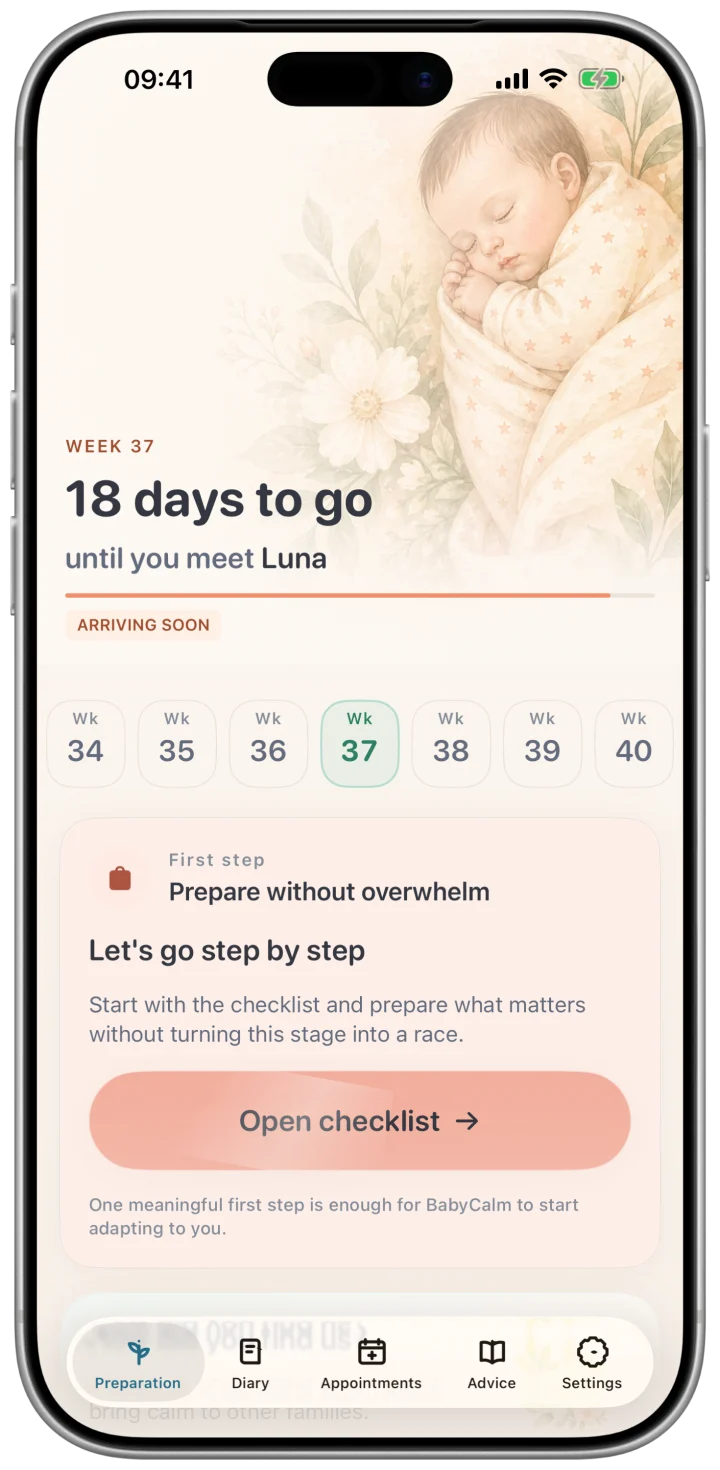
In BabyCalm, pregnancy mode shows your week, what to prepare, a diary and your appointments. Once your baby arrives, the same app logs sleep, feeds and diapers in one tap, and the essentials are free. If you want to know what happens to your data, we explain it in our privacy policy.
Frequently asked questions
Is it normal to barely show at 20 weeks?
It can be. The NHS places the start of showing in the second trimester, which lasts until week 27, and does not give a set size for each week. Your baby's growth is checked on the scan. If it worries you, ask at your appointment.
When will I feel my baby move?
According to the NHS page on your baby's movements, between 16 and 24 weeks. If this is your first baby, you might not feel movements until after 20 weeks. If you have not felt your baby move by 24 weeks, the NHS advises telling your midwife.
Can I sleep on my back?
The NHS recommends going to sleep on your side from 28 weeks, and does not give specific advice for week 20. If you wake up on your back later on, the NHS says not to worry: just turn onto your side and go back to sleep.
Do creams prevent stretch marks?
The NHS and ACOG agree there is no proof that they do. A moisturiser can keep your skin softer and ease itching, but it will not make stretch marks go away. Most fade over time after the baby is born.