 BabyCalm
Here is what the WHO, the NHS and the Spanish Association of Paediatrics (AEP) say, how to spot when your baby is getting sleepy, and a simple way to find their own rhythm.
Key points
- "Wake window" does not appear in the official guidance we checked. The tables with exact minutes you see online do not cite an official source.
- The WHO recommends 12 to 16 hours of sleep in 24 hours from 4 to 11 months, including naps.
- According to the NHS, yawning, turning away or closing their eyes can mean your baby needs a break, and may be ready for sleep or a feed.
- The AEP explains that sleep starts to organise itself between 3 and 6 months, and that babies do not have a regular sleep rhythm until around 6 months.
- Noting down when your baby wakes and falls asleep for a few days will teach you more about their rhythm than any table.
What is a wake window?
It is a popular name for the time a baby spends awake between one sleep and the next. The idea behind it is simple: if you start getting your baby ready for sleep when they show signs of tiredness, they often find it easier to settle.
The term does not appear in the NHS or AEP pages we checked. Online you will find tables that give, for example, between one and three-quarter hours and two and a half hours at 4 months, or even an exact time for each nap. We could not find those figures in any official source, so we would rather not give you a number that may not fit your baby and leave you thinking something is wrong.
What official sources do offer is useful information on how much babies sleep at this age, how to recognise tiredness, and what helps sleep settle into a pattern.
How much does a 4-month-old sleep?
The WHO guidelines on physical activity, sedentary behaviour and sleep for children under 5 recommend 12 to 16 hours of good-quality sleep from 4 to 11 months, including naps. From 0 to 3 months, it is 14 to 17 hours.
That range is wide on purpose. The NHS guide to helping your baby sleep says that some babies sleep much more than others, and that your baby's pattern is unlikely to match other babies you know. Between 3 and 6 months, some babies sleep for 5 to 8 hours or longer at night, but not all.
| What the guidance says | Source |
|---|---|
| 4 to 11 months: 12 to 16 hours of sleep in 24 hours, including naps | WHO |
| 3 to 6 months: some babies sleep 5 to 8 hours or longer at night, but not all | NHS |
| Around 6 months: babies often sleep up to 5 hours in a row at night | AEP |
| No regular sleep rhythm until around 6 months | AEP |
How can I tell my baby is getting sleepy?
Watching your baby tells you more than the clock. The NHS guide to understanding your baby describes several "states" babies move through during the day, and what you can do in each one.
Signs your baby needs a break
The NHS explains that babies can easily become overwhelmed or tired. Signs include sneezing, yawning, hiccupping, turning away, closing their eyes or bringing up some milk. When you notice them, it suggests slowing down, stopping the activity or moving somewhere quieter. Your baby may be ready for a sleep or a feed.
The drowsy state
The NHS describes it like this: eyes open but glazed, heavy-lidded or closed with fluttering eyelids, and few body movements. Many parents call it "the faraway look".
| What you notice | What it may mean, according to the NHS | What you can do |
|---|---|---|
| Yawning, turning away or closing their eyes | Needs a break | Stop the activity and find somewhere quiet; they may want to sleep or feed |
| Glazed eyes, heavy eyelids | Drowsy | Dim the lights, lower the noise and start your sleep routine |
| More active, fussing, more sensitive to noise | Needs a change of pace | Slow down or change what you are doing; at night, it may be a feed |
| Crying hard and difficult to comfort | Crying | Stop what you are doing and soothe them with something calm and repetitive |
Telling tiredness from hunger is not always easy, and the NHS itself mentions both. If you are unsure, try whichever seems more likely and see how your baby responds.
Why does it change so much from day to day?
Because your baby's sleep is still maturing. The AEP's article on the stages of sleep (in Spanish) explains that between 3 and 6 months, melatonin, cortisol and body temperature start to regulate. Babies begin to organise their sleep around walks, baths and feeds, and take less time to fall asleep.
The AEP also notes that babies do not have a regular sleep rhythm until around 6 months. And the NHS reminds parents that growth spurts, teething and illness can all affect how a baby sleeps, so routines will need to change as your baby grows.
If nights have become harder just now, our article on the 4-month sleep regression may help.
What kind of routine can help?
Show the difference between day and night
The NHS suggests teaching your baby from the start that night-time is different from daytime. During the day, open the curtains, play, and do not worry about everyday noise while they sleep. At night, keep the lights low, talk little and quietly, put your baby down as soon as they have been fed and changed, only change their diaper if it needs it, and do not play.
A calm bedtime routine
The NHS describes a simple, soothing routine: a bath, night clothes and a fresh diaper, dimmed lights, a cuddle and a lullaby. The AEP suggests something similar, such as bath, massage and a song, ending in the bedroom. What matters is that it is simple and similar each night, not the exact order.
Awake time counts too
The WHO recommends that babies who are not yet mobile spend at least 30 minutes a day on their tummy while awake, spread through the day, and are not restrained for more than an hour at a time, for example in a pram or high chair. Floor play with you is part of the rhythm of the day.
Wait a moment before stepping in
When your baby wakes, the AEP suggests waiting a few minutes to see if they fall back asleep. If they stay unsettled or cry, pick them up, comfort them and give them what they need.
How do I find my baby's own rhythm?
Rather than following someone else's table, look at your baby's. For three or four days, note down just three things: when they wake, when they fall asleep, and their feeds. By the end you will see roughly how long they usually stay awake before showing tiredness, and whether that changes between morning and afternoon.
You do not need to be exact to the minute. A rough idea is enough to get a little ahead: as the time when they usually tire approaches, slow things down and start your routine. If one day does not fit, that is fine; tomorrow will be different.
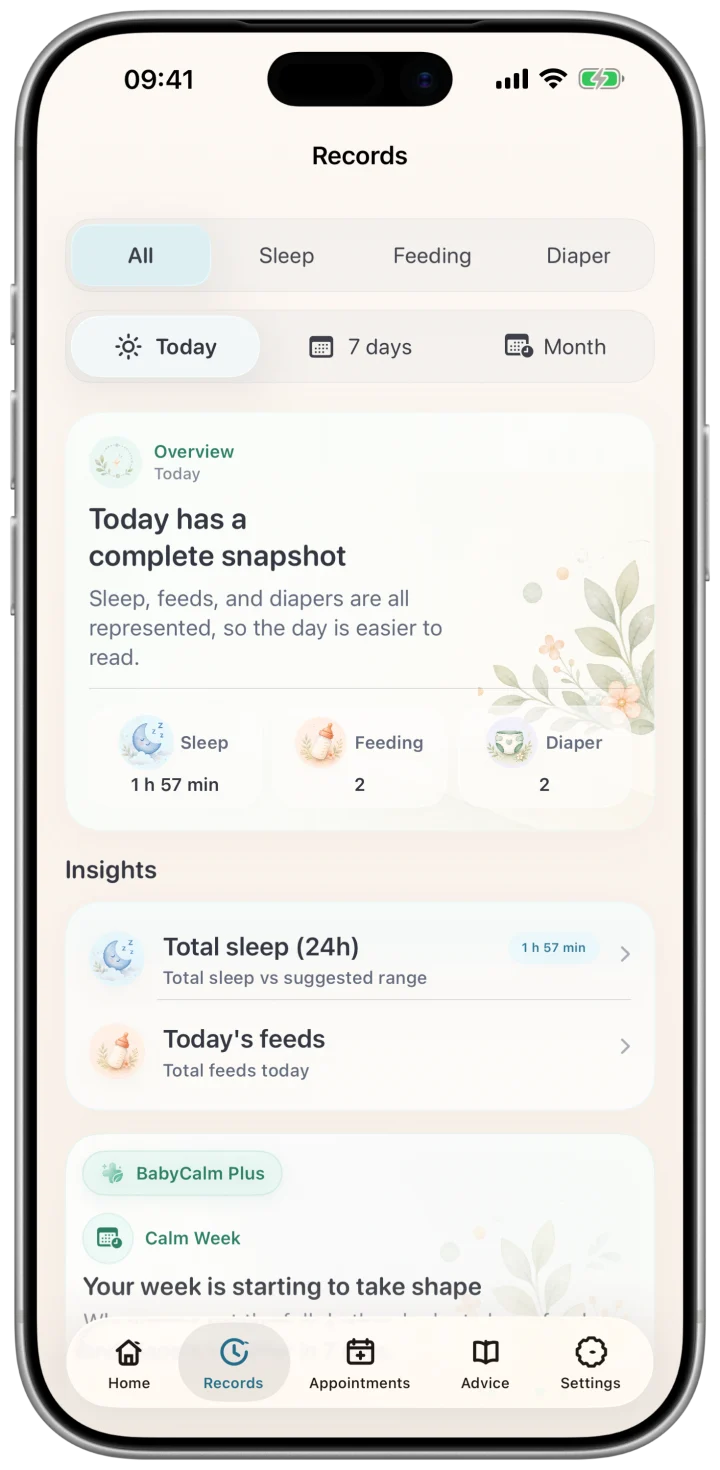
With BabyCalm you log sleep, feeds and diapers with one tap, and the essentials are free. If you want to know what happens to your data, our privacy policy explains it. A sheet of paper on the fridge works too.
Where and how should my baby sleep?
Whatever your baby's rhythm, the NHS guide to reducing the risk of sudden infant death syndrome (SIDS) recommends, for every nap and at night:
- always placing your baby on their back, with their feet at the foot of the cot;
- a separate cot or Moses basket in the same room as you for at least the first 6 months;
- a firm, flat mattress, with no pillows, duvets, bumpers, loose blankets or soft toys;
- keeping the room between 16 and 20°C;
- not sleeping with your baby on a sofa or in an armchair.
When should I talk to a doctor?
The NHS suggests speaking to your health visitor if your baby is having problems sleeping or you need more advice about a routine. The AEP's article on sleep problems (in Spanish) advises asking for help when sleep problems significantly affect daily life, for example with many night wakings or when they are affecting the whole family. Your baby's doctor or nurse can help too.
Some changes have nothing to do with sleep. The NHS page on fever in children advises getting medical advice the same day if your baby is under 3 months with a temperature of 38°C or higher, 3 to 6 months with 39°C or higher, or has a fever with other signs of illness, such as a rash.
According to the same page, call your local emergency number if your baby has difficulty breathing, has blue or grey lips or skin, is drowsy and hard to wake, or is not responding as they normally do.
Frequently asked questions
How many naps does a 4-month-old take?
The official guidance we checked does not set a number of naps at this age. The WHO talks about total sleep over 24 hours: 12 to 16 hours, including naps. Short, frequent naps or fewer, longer ones can both be normal.
Should I wake my baby from a long nap?
The NHS advises trying not to wake a baby in deep sleep and using the time to rest yourself. The AEP says you do not need to wake your baby to feed unless their doctor has told you to.
What if my baby was born early?
The AEP explains that corrected age is the age your baby would be if they had been born on their due date, and that it is used to assess their development. You can read more in its article on corrected age (in Spanish). If you have questions about their sleep, ask your baby's doctor.
What time should I put my baby to bed?
There is no official bedtime. The AEP suggests keeping similar times each day, and the NHS a simple, calm routine before bed. Your baby's tiredness cues will help you find the time that suits your family.