 BabyCalm
Here are the sizes for each week, with a comparison to help you picture them, what's developing along the way and what scans can show. It's general guidance: these numbers can't tell you how your baby is doing. That's for your care team.
Key points
- According to the NHS, your baby is about 2 mm at week 4, about 15 cm at week 19 and about 51 cm at week 40.
- The NHS measures from head to bottom in the early weeks and to the heel from week 20. That's why growth seems to jump.
- Fruit and vegetable comparisons help you picture the size, but they aren't an exact scale and they vary between sources.
- According to the NHS, hospitals in England offer at least two scans: one at 11 to 14 weeks and one between 18 and 21 weeks. Schedules vary by country.
- If you notice a change in your baby's movements, the NHS says to call right away, even in the middle of the night.
How big is your baby each week?
These sizes and comparisons come from the NHS week-by-week guide. Each week number links to its page. We've adapted a few food names for US readers.
Weeks 4 to 13
| Week | Approximate size | To picture it |
|---|---|---|
| 4 | 2 mm | a poppy seed |
| 5 | 2 mm | a sesame seed |
| 6 | 6 mm | a pea |
| 7 | 10 mm | a grape |
| 8 | 16 mm | a raspberry |
| 9 | 22 mm | a strawberry |
| 10 | 30 mm | a small apricot |
| 11 | 41 mm | a fig |
| 12 | 5.4 cm | a plum |
| 13 | 7.4 cm | a peach |
Weeks 14 to 27
| Week | Approximate size | To picture it |
|---|---|---|
| 14 | 8.5 cm | a kiwi |
| 15 | 10.1 cm | an apple |
| 16 | 11.6 cm | an avocado |
| 17 | 12 cm | a pomegranate |
| 18 | 14.2 cm | a bell pepper |
| 19 | 15.3 cm | a large tomato |
| 20 | 25.6 cm | a banana |
| 21 | 26.7 cm | a carrot |
| 22 | 27.8 cm | a sweet potato |
| 23 | 28.9 cm | a large mango |
| 24 | 30 cm | an ear of corn |
| 25 | 34.6 cm | a zucchini |
| 26 | 35.6 cm | a cucumber |
| 27 | 36.6 cm | a head of cauliflower |
Weeks 28 to 40
| Week | Approximate size | To picture it |
|---|---|---|
| 28 | 37.6 cm | an eggplant |
| 29 | 38.6 cm | a butternut squash |
| 30 | 39.9 cm | a cabbage |
| 31 | 41.1 cm | a coconut |
| 32 | 42.4 cm | a bunch of celery, in length |
| 33 | 43.7 cm | a pineapple |
| 34 | 45 cm | a cantaloupe |
| 35 | 46.2 cm | a honeydew melon |
| 36 | 47.4 cm | a head of romaine lettuce |
| 37 | 48.6 cm | a leek, in length |
| 38 | 49.8 cm | a stick of rhubarb, in length |
| 39 | 50.7 cm | a small watermelon |
| 40 | 51.2 cm | a pumpkin |
Why does growth seem to jump at week 20?
The table goes from 15.3 cm at week 19 to 25.6 cm at week 20. That doesn't mean your baby grew 10 cm in a week. The NHS page for week 20 explains that measurements now run from head to heel. Before that, they run to the bottom, because the legs are curled up and hard to see. If you are at that point now, here is what is normal for your bump at 20 weeks.
Comparisons are only a way to picture it
A piece of fruit isn't a measurement. In the NHS guide itself, the kiwi at week 14 comes after the peach at week 13, even though a kiwi is usually smaller. Other websites and apps use different foods for the same week. A different comparison doesn't mean anything is off.
What's developing along the way?
These are some of the milestones the NHS lists on the same pages. They're a general guide, and every pregnancy has its own pace.
Weeks 4 to 8
- Week 5: the face starts to take shape, and the brain and spinal cord form quickly.
- Week 6: arms and legs begin as small limb buds, and there's a bump where the heart is.
- Week 8: the arms get longer. Around now, the embryo becomes a fetus.
Weeks 9 to 13
- Week 9: the face looks more recognizable, with eyelids, a mouth and a tongue. The heart, brain, lungs, kidneys and gut are developing.
- Week 11: fingers and toes separate, and tiny fingernails appear.
- Week 12: the internal organs and muscles have grown, and the heartbeat can be picked up on a scan.
- Week 13: your baby moves, jerkily at first and then more deliberately. You may not feel it yet.
Weeks 14 to 19
- Week 14: the head gets rounder and more in proportion. Your midwife or doctor may be able to hear the heartbeat with a handheld monitor.
- Week 15: a soft layer of hair called lanugo grows, and eyebrows and eyelashes begin. The eyes are sensitive to light, and hearing starts around now.
- Week 17: your baby reacts to loud noises and opens and closes their mouth.
- Week 19: your baby keeps putting on weight.
Weeks 20 to 27
- Week 20: a white, greasy layer called vernix covers the skin. It's thought to protect it from drying out.
- Week 21: your baby is now heavier than the placenta.
- Week 23: the limbs are in proportion, and you may start to see your belly move.
- Week 25: this is an active time. A loud noise can make your baby jump, and you may feel the odd hiccup.
- Week 26: the eyes open for the first time, around now.
Weeks 28 to 36
- Week 28: the heart beats at around 140 beats per minute.
- Week 29: your baby is fully formed. Over the next few weeks, the organs mature and fat builds up.
- Week 31: your baby is very active and starts to recognize voices from outside.
- Week 33: the bones harden, except for the skull bones, which stay soft and separate until around 12 to 18 months.
- Week 35: your baby is getting chubbier, which will help them stay at the right temperature after birth.
Weeks 37 to 40
- Week 37: your baby tries out expressions, like frowning and smiling. The NHS notes these are random.
- Week 38: the lanugo is mostly gone, and meconium, which becomes the first poop, builds up in the bowels.
- Week 39: the skin grows a tougher new layer.
- Week 40: space is tight, but your baby should still move in their usual pattern. If you notice a change, call your midwife, doctor or maternity unit.
What can each scan show?
Scans are the real pictures of your baby during pregnancy. The NHS explains that they use sound waves to build the image, that they're painless and that they have no known side effects. Your own schedule depends on where you live, so check with your midwife or doctor.
| Scan | When (NHS) | What it's for |
|---|---|---|
| 12-week scan | 11 to 14 weeks | Estimating how far along you are and your due date, checking how many babies there are, where the baby is growing and how they're developing |
| 20-week scan | 18 to 21 weeks | Looking for 11 conditions and checking growth, including the bones, heart, brain, spinal cord, face, kidneys and belly |
The NHS adds that you may be offered more scans depending on your health and your pregnancy.
What about before week 11?
The NHS guide for week 6 says the heartbeat can sometimes be picked up by a vaginal ultrasound, though in the UK you're unlikely to be offered one unless you've had IVF. If you have an early scan and you're unsure about it, ask the person doing it what can be seen at that stage.
What the scan is usually like
According to the NHS, it takes place in a dimly lit room. Gel goes on your belly, a probe moves over it and the picture appears on a screen. You may be asked to come with a full bladder.
Sometimes the baby is moving a lot or isn't in a good position. The NHS guide to the 20-week scan says you may be asked to walk around or eat something and come back, or be offered another appointment. It explains this is so that all the checks can be done.
If you'd like a picture or want to know the sex
Ask where you're being seen, because it varies. The NHS says to check whether your hospital provides pictures and that there may be a charge. It also says most scans at week 12 can't tell the sex yet, and that at the 20-week scan it depends on hospital policy.
What a scan can't tell you
The NHS notes that the 20-week scan can't find every condition. It also says it's your choice whether to have it. If you have questions about a result, you can ask your care team as many as you need to.
When will you feel your baby move?
The NHS guide to baby movements says you should start to feel them between weeks 16 and 24. With a first baby, it might not be until after week 20. If you haven't felt movement by week 24, tell your midwife or doctor.
From then on, you don't need to count kicks. The NHS suggests getting to know your baby's usual pattern, and says you should feel movement right up to and during labor.
When is it worth calling before your next appointment?
You can call whenever you have a question or something worries you, at any stage. The NHS says to call your midwife or maternity unit right away, even in the middle of the night, if your baby is moving less than usual, if you can't feel movement or if the pattern changes.
The NHS guide to pregnancy symptoms also asks you to get checked for:
- Vaginal bleeding or fluid leaking from the vagina.
- Sudden swelling in your face, hands, legs or feet.
- Sudden blurred vision or flashing lights, or a severe headache.
- Shortness of breath that comes on suddenly, when you lie down, or with chest pain or dizziness.
- A fever of 38 °C (100.4 °F) or higher.
- Very severe vomiting, itchy skin or any pain that worries you.
- Stress, anxiety or low mood that affects your daily life. Support is available.
Call your local emergency number if you think it's life-threatening. Do the same if you're bleeding heavily, or bleeding with severe belly pain, shoulder pain, dizziness or fainting, as the NHS guide to bleeding explains.
How can you follow it without the stress?
You don't need to keep an eye on the centimeters. It's enough to know what week you're in, which appointments you have and what you want to ask. If you don't note anything down one day, that's fine.
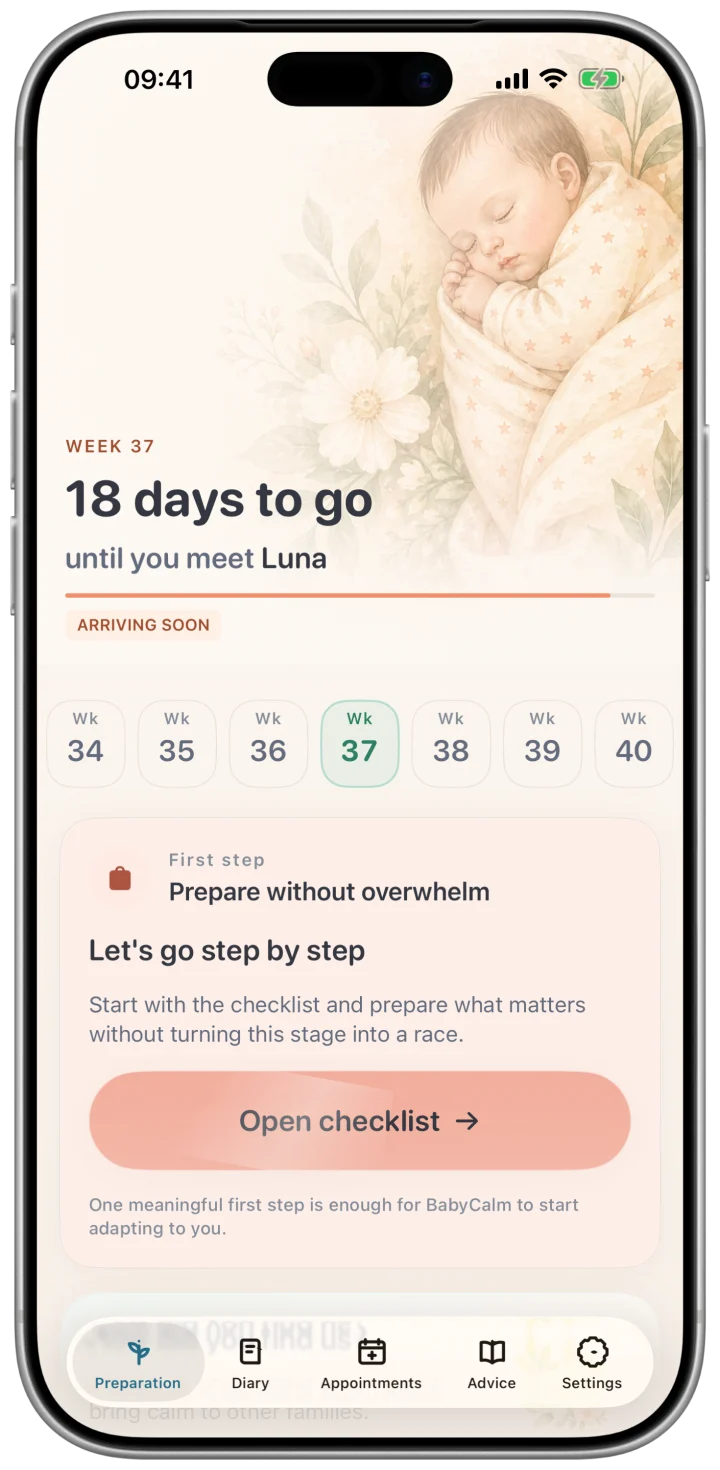
The pregnancy mode in BabyCalm shows your week with an illustrated size guide, preparation steps, a journal and your appointments. Its comparisons don't always match the NHS ones, since they're also just a way to picture it. Once your baby is born, you can log sleep, feeds and diapers with one tap. The essentials are free, and our privacy policy explains what happens with your data.
Frequently asked questions
How big is a baby at 20 weeks?
The NHS estimates about 25.6 cm from head to heel, roughly the size of a banana. It's an approximate figure. The scan around that time also checks your baby's growth.
What week can you see the baby on a scan?
The NHS says hospitals in England offer the first routine scan at 11 to 14 weeks and the next between 18 and 21 weeks. You may be offered more depending on your health and your pregnancy, and schedules vary by country.
What if my scan shows a different size from the table?
The table isn't a target your baby has to hit. These are general figures from a guide, and they don't replace your own tests. Your care team is the one to interpret your measurements, so ask them whatever you need.
Why does every website use a different fruit?
Because it's a way to picture the size, not a measurement. There's no single official list: here we use the NHS one, and other sources choose other foods.
Can you find out the sex at the first scan?
The NHS says most scans at week 12 can't tell yet. At the 20-week scan, you may be asked whether you'd like to know, depending on the hospital.