 BabyCalm
Here is the full list, split into bags, a simple timeline so you can pack without rushing, and the questions worth asking your hospital, since they know best what they will give you there.
Key points
- The NHS suggests having your bag packed at least 3 weeks before your due date.
- Split things into bags: documents, labour, you on the ward, the baby and your birth partner.
- Pack two packets of super-absorbent maternity pads: bleeding after the birth is heavy at first.
- For the drive home, your baby needs an approved, rear-facing car seat, ideally in the back seat.
- Ask your hospital what they provide (diapers, gowns, clothes) so you do not carry things you will not use.
When should you pack your hospital bag?
The NHS hospital bag checklist points out that babies do things in their own time and only 1 in 20 arrives on the due date. So it suggests having your bag ready at least 3 weeks ahead. If your due date is at 40 weeks, that means around week 37.
You do not have to do it all at once. Packing in stages is less tiring and gives you time to buy what is missing. This timeline is just one practical way to spread it out:
| When | What to prepare |
|---|---|
| Weeks 28 to 32 | A birth plan, if you want one, and a folder for your notes |
| Weeks 32 to 34 | Wash the baby's clothes, buy pads and diapers, set up the bags |
| Weeks 34 to 36 | Fit the car seat and finish the labour and ward bags |
| From week 37 | Everything by the door, with a note of what to grab on the day |
Weeks 28 to 32 are not random. Spain's Ministry of Health says in its birth plan template (in Spanish) that you can write a birth plan at any point in pregnancy, but that this is a good time, and that you can take your questions to your midwife.
Which documents should you bring?
Documents take up little space and are the hardest thing to replace. Keep them in a folder in the bag that stays with you, not the one left on the ward.
- Your ID and any health card your system uses.
- Your pregnancy notes. The NHS lists your hospital notes first.
- Your birth plan, if you have one.
- Your partner's ID, if you plan to register the birth at the hospital.
- Anything your insurer asks for, if you are going private.
A birth plan is not a contract. Spain's Ministry of Health notes that during labour you can change any of the preferences you wrote down, depending on how you feel and how things go.
What should you pack for yourself?
This is the NHS list, lightly adapted. Trim it to the days you expect to stay and to what your hospital provides.
For labour
- Loose, comfortable clothes to wear in labour.
- A dressing gown and slippers or flip-flops, which also work in the shower.
- Socks.
- Snacks, drinks and a water bottle. The NHS says one with a straw may be handy.
- A fan or water spray to keep cool.
- Music, a book or podcasts for the waiting.
- Your phone and charger, ideally with an extra-long cable or a battery pack.
Ask ahead about what you can wear. The Spanish birth plan template lets you choose between your own clothes and hospital clothes, and not every hospital offers the same options.
For your stay on the ward
- Nightwear that opens at the front or is loose, if you plan to breastfeed.
- Three changes of comfortable clothes.
- Five or six pairs of underwear. The NHS says disposable ones may be useful.
- Two or three comfortable bras, nursing bras if you plan to breastfeed, and breast pads.
- Two packets of super-absorbent sanitary or maternity pads.
- A wash bag: toothbrush and toothpaste, hairbrush, soap, lip balm, deodorant, hair bands, hand sanitiser and body lotion.
- A towel and, if you like, your own pillow.
- An eye mask: the NHS says it may help you sleep on a brightly lit ward.
- Any medicines you take.
- Spare glasses or contact lenses, if you wear them.
- A spare bag for washing.
Why so many pads? The NHS page on your body after the birth explains that bleeding is quite heavy at first and lasts a few weeks. It recommends pads, not tampons, until your 6-week postnatal check.
What does your baby need in hospital?
Very little, and most of it small. The NHS sums it up like this:
- Bodysuits, vests and sleepsuits.
- An outfit for going home.
- A hat, scratch mittens and socks or booties.
- A snowsuit, if it is cold.
- Diapers.
- Cotton wool or wipes.
- Muslin squares.
- A blanket or shawl.
- A car seat for the trip home.
You will not know your baby's weight until they are born, so it makes sense to pack a few things in newborn size and a few in 0 to 1 month. Wash them first and keep each size in its own bag, so whoever is with you can find things without searching.
For feeding, ask your hospital what they have on the ward. That way you can decide calmly what to pack, whether you plan to breastfeed, bottle feed or do both. If you are thinking of combining, see our guide to combination feeding.
How should your baby travel home by car?
If you are driving home, fit the car seat a few weeks early and practise taking it in and out. Rules vary by country, so check your local guidance. Spain's traffic authority, the DGT, sums up the basics in its guide to travelling with children (in Spanish):
- The seat must be approved and suitable for your baby's weight and height.
- As a general rule, it goes in the back seat.
- Seats for the youngest babies face backwards.
- It should not go in a seat with an airbag, unless the airbag can be switched off.
- Fit it following the manufacturer's instructions.
- Never hold a baby in your arms in the car. The DGT explains that, even in a 5 km/h crash, no adult could hold on to them.
What should your birth partner bring?
Hospital hours feel long for the person with you too. The NHS suggests:
- A change of clothes.
- Toothbrush, toothpaste and deodorant.
- Phone and charger.
- Snacks and drinks.
- Swimwear, if they will be getting into a birth pool.
- Any medicines they take and spare glasses, if they wear them.
- Change for the car park and vending machines.
They are usually the one carrying the bags, so it helps if they know what is in each one.
What about registering the birth?
How you register a birth depends on where you live. In Spain, it can be done from the hospital itself, and if it is not, parents have ten days to declare the birth at the Civil Registry, according to administracion.gob.es. Elsewhere, ask your midwife or the ward how it works and which documents you will need.
What if labour starts before your bag is ready?
The only thing you cannot improvise is your documents. Everything else can be brought in later by whoever is with you.
Call before you set off. The NHS page on the signs of labour says to call your midwife or maternity unit if you think you are in labour or have regular contractions every 5 minutes or more often. Call straight away, even at night, if your waters break, if you have vaginal bleeding or if your baby is moving less than usual. If you think your baby is coming now, call your local emergency number.
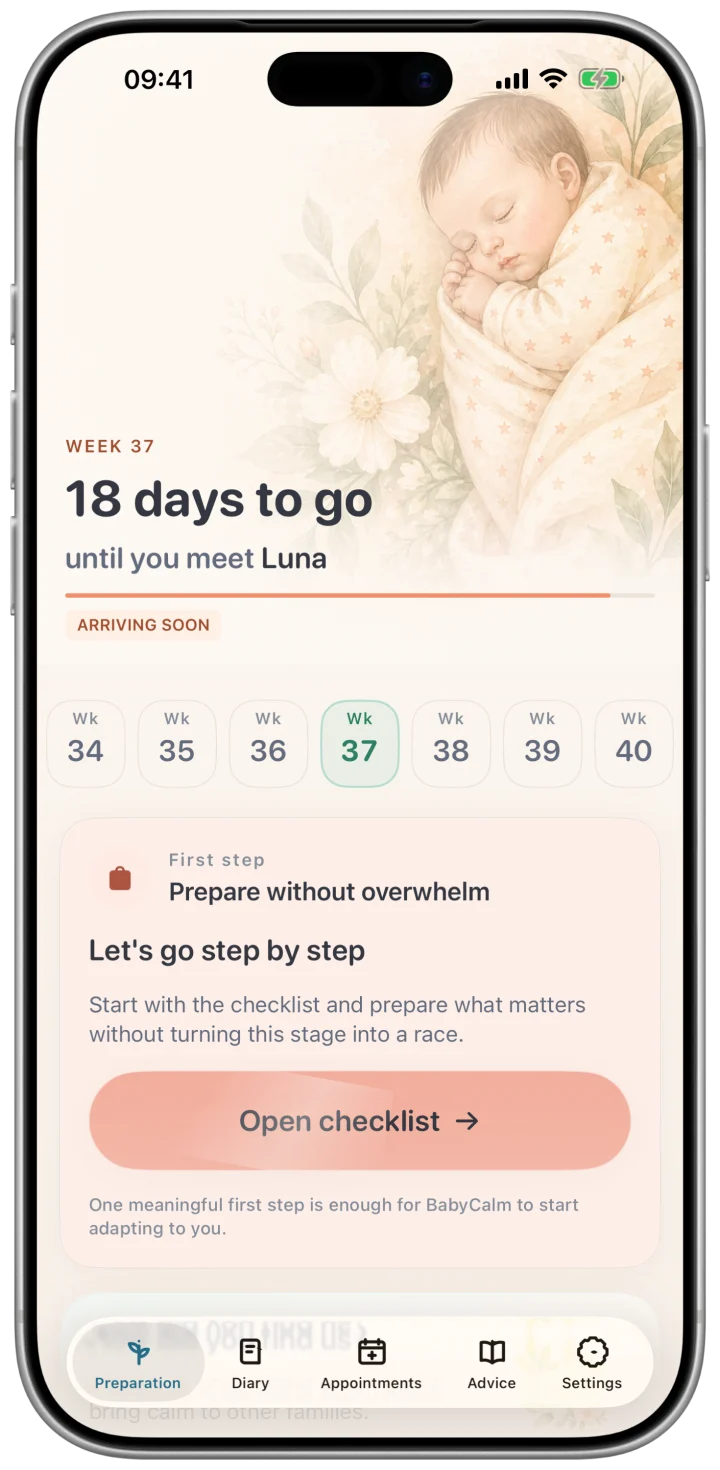
If you want to keep all of this in one place, BabyCalm's pregnancy mode shows what to prepare at each stage and lets you save questions for each appointment, such as what your hospital provides.
Frequently asked questions
What goes into the labour room and what stays on the ward?
It depends on the hospital. A practical approach is a small bag with your documents and labour things, and the rest ready for when you move to the ward. Ask on your hospital tour.
How many days should you pack for?
It depends on the birth and the hospital. After a caesarean, the NHS says most women can go home after 1 or 2 days. If you stay longer, someone can bring more from home. There is more on this in our article on packing for a vaginal birth or a caesarean.
Do you need diapers if the hospital provides them?
Many hospitals provide them, but not all. The NHS includes them in its list. Ask yours and, if you are not sure, pack a small pack in newborn size.
Can you wear your own clothes in labour?
The Spanish Ministry of Health's birth plan includes that preference, so you can ask for it. Each hospital has its own rules: check ahead and pack loose clothes anyway.
In BabyCalm, pregnancy mode shows your week, what to prepare, a diary and your appointments. Once your baby arrives, the same app logs sleep, feeds and diapers with one tap, and the essentials are free. If you want to know what happens to your data, we explain it in our privacy policy.